Research Interests
My interests lie in the relationships between soil and the environment, particularly the regulation of fluxes of gases, nutrients and elements between the soil and the atmosphere, the biosphere and the hydrosphere and the effect of human activities and climate change.
For the past decade, most of my attention has focused on peatlands and wetlands and the controls on the cycling of carbon in these systems. Northern peatlands contain one third of the global soil carbon pool, store carbon dioxide (CO2) in accumulating peat, emit methane (CH4) to the atmosphere and are major sources of dissolved organic carbon (DOC). My work, in landscapes ranging from the Northwest Territories to Nova Scotia, has attempted to measure the magnitude of these fluxes, to establish the important controls, to develop models and to examine the effect of changes, such as directly anthropogenic (for example, through the drainage or flooding of peatlands) or indirectly (for example, through climatic change and atmospheric nitrogen deposition) on carbon cycling. Thus, my work integrates aspects of atmospheric chemistry, plant ecology, hydrology, microbiology and soil science in a search to understand biogeochemical patterns in the landscape.
Research opportunities
Dynamics and chemistry of dissolved organic carbon (DOC) and nitrogen in peatlands: Although we know the concentration of DOC in peat porewater and can estimate export of DOC from a peatland, we have little understanding on the rates of DOC production, consumption and transport within peatlands, and its role in N cycling. This study will be based at Mer Bleue and involve both field-work and laboratory experiments to determine where the DOC comes from and how it is processed by the column, and linking with peatland C models.
Nitrogen fixation in peatlands: Peatlands store substantial amounts of nitrogen (N) along with carbon (C); the main input of N to peatlands is from the atmosphere or through N2 fixation, but little is know about the latter process. This project will examine the rates of N2 fixation at the range of sites (hummock-hollow-beaver pond-fertilized plots) at Mer Bleue using the acetylene reduction method, and establish the major controls on these N2 fixation rates.
Root dynamics in peatlands
Below-ground activities in ecosystems are the ‘Final Frontier’ (Science [2004] 304: 1614-1637) and this is probably particularly the case in wetlands. We have established gradients of species composition and production at Mer Bleue in response to water table position - above:belowground quotients range from 0.3 to 0.6. Mini-rhizotron tubes inserted to the rooting depth along a hummock-hollow sequence and in the fertilizer plots will measure root demographics at monthly intervals.
Response of a bog community to N and P additions
Bogs are oligotrophic and ombrotrophic systems, with low nutrient availability and are being exposed to increased nutrient inputs, especially increases in atmospheric N deposition. To determine the long-term effect of increased nutrient additions, in 2000 I established a study at Mer Bleue with triplicated plots 3 x 3 m with treatments representing 0, 1.6, 3.2, and 6.4 g N m-2 y-1, or 5, 10, and 20 times the growing-season N deposition and about 2, 4 and 8 times the annual deposition. Opportunities are available to establish the response of plant species and their C exchange, of nutrient uptake and release and of ecosystem CO2, CH4 and N2O exchange.
Research Themes
Peatland biogeochemistry
Mer Bleue is the eastern peatland within the Canadian Carbon Program (http://www.fluxnet-canada.ca ). At this site (Figures 1 to 5) an eddy covariance tower operated by Elyn Humphreys (Carleton University) and Peter Lafleur (Trent University) has measured CO2 exchange since 1998 providing an assessment of the seasonal and interannual variability and the influence of changes in climate and water table. Combination of CO2 exchange, CH4 flux and DOC export over 6 years provides an estimate of the interannual variability of the overall C flux in this system (Rouklet et al. 2007).
My work at Mer Bleue, in collaboration with Jill Bubier (Mount Holyoke College, MA), has involved studies of rates of decomposition of litter and peat (e.g. Scanlon and Moore 2000; Moore et al. 2007), of biomass and plant production and distribution (e.g. Moore et al. 2002; Bubier et al. 2006), of CO2 exchange from chambers covering the range of vegetation types from bog to beaver pond (e.g. Bubier et al. 2003) and controls on ecosystem respiration (Lafleur et al. 2006) and the onset of spring photosynthesis in this system (Moore et al. 2006). We have measured CH4 flux at 12 sites over 5 years to define the environmental controls (Moore et al. submitted) and Kerry Dinsmore and Mike Billett (Centre for Ecology and Hydrology, Penicuik, Scotland) have examined fluxes from the beaver ponds).
To evaluate the effect of nutrients on the bog, we are conducting a long-term (12-year +) fertilization with N, P and K, and determining plant and CO2 flux response: vegetation (Fig. 6) and CO2 exchange changes have been observed among the 6 experimental treatments (Bubier et al. 2007; Juutinen et al. in press). Christian Blodau (University of Guelph) conducted a 15N tracing experiment at the fertilized plots (Xing et al. in press). Although there is increased N concentration in shrub leaves in the fertilized plots, there is a weak response in leaf photosynthesis suggesting that, in these bog shrubs, N uptake is stored rather than being in a form enhancing photosynthesis (Bubier et al. submitted). Work by PhD student Meng Wang suggests that the vegetation at Mer Bleue is mainly N and P-limited and nutrient limitation in the fertilized plots will be determined in 2011.
Focus is now being placed on linking the C and N cycles, involving measurements of microbial activities (Basiliko et al. 2005), of [N] and 15N in vegetation and peat, incubation studies of rates of NH4+, NO3- and dissolved organic nitrogen production and N fixation. MSc student Amanda Alfonso is establishing whether peatland plants can take up organic N, using 13C and 15N labeled glycine.
Although we know a lot about above-ground plant activities, understanding the role of roots in peatlands is weak. Post-doctoral Fellow Meaghan Murphy has determined below-ground activities at the Mer Bleue peatland (Murphy et al. 2009 and Murphy and Moore in press) and has installed mini-rhizons to determine root demography and phenology in the peatland and in the fertilization plots.
As part of a broad study of the C dynamics of peatlands in the James Bay region, in collaboration with Nigel Roulet, Jukka Turunen (Geologic Survey of Finland, Kuopio), Michelle Garneau (UQAM) and Pierre Richard (Université de Montréal), M.Sc. student Luc Pelletier measured CO2 and CH4 fluxes from peatlands and small pools Pelletier et al. 2007) and Ph.D. student Nicola McEnroe (McEnroe et al. 2009) examined the biogeochemistry of pools in these northern peatlands.
Sampling of ombrotrophic bogs from northwestern Ontario to the Maritimes and their dating with 210Pb has provided an assessment of recent rates of accumulation of C, N and S in peat and the influence of climate and atmospheric N and S deposition (Turunen et al. 2004; Moore et al. 2005). To estimate industrial contaminant deposition, the cores have been analyzed for poly-aromatic hydrocarbons (Christian Blodau and Anna Dryer, University of Bayreuth). The cores have been analyzed for Hg by Brian Branfireun (University of Western Ontario), to provide a record of the spatial and temporal variation in atmospheric Hg deposition in eastern Canada.
Methane and graves
As part of a SSHRC-sponsored project on the detection of clandestine graves led by Margaret Kalacska, Mike Dalva and I have been examining patterns of CH4 emission from soils in an animal graveyard of Parc Safari Africain, near Hemmingford, QC. Graves emit large amounts of CH4 to the atmosphere, sampling of the [CH4] in the atmosphere just above the soil surface at dawn after a still night reveals the patterns of graves and the soils around graces show high rates of both CH4 production and consumption.
Methane and nitrous oxide fluxes from Canadian forests
A three-year CFCAS and BIOCAP grant allowed the determination of CH4 and N2O exchange between forest soils and the atmosphere. Sites included the Turkey Point ON (Altaf Arain, McMaster University), Chibougamau QC (Hank Margolis, Univesité Laval) Canadian Carbon Program sites, plus sites in northern Quebec and Mont St. Hilaire and Morgan Arboretum, near Montreal, directed by Research Associate Sami Ullah (now Universities of Lancaster and Keele, UK). The magnitude and controls on the fluxes of these two greenhouse gases has been established (Peichel et al. 2010; Ullah et al. 2009; Ullah and Moore 2009, submitted). In addition, laboratory studies have identified microbial and biogeochemical controls on fluxes (Ullah et al. 2008; Frasier et al. 2010). A synthesis of greenhouse gas fluxes in Canadian forest soils is being prepared.
Dissolved organic carbon (DOC) in forests
We examined the role of DOC in C cycling within upland forests, supported by BIOCAP and NSERC. Measurements were made of field DOC fluxes, and laboratory experiments performed on DOC production, biodegradability, sorption and chemistry and modelling (Ph.D. students Julie Turgeon and Dolly Kothawala). Sources, sinks and fluxes of DOC were made at the Turkey Point ON (Peichl et al. 2007) and Campbell River BC Fluxnet sites. Sorption studies revealed the importance of mineral soil chemistry on DOC and N sorption (Kothawala et al. 2008, 2009) and DOC production studies revealed the importance of DOM chemistry and temperature (Moore et al. 2008).
Litter decomposition and ecological stoichiometry
Rates of litter decomposition in litter-bags over 5 to 6 years have been determined at several peatland sites across eastern Canada (e.g. Schefferville QC, Sept-Iles QC, Mont St Hilaire QC, Mer Bleue ON and Experimental Lakes Area, ON). Controls of litter chemistry and site have been established (Moore et al. 2007) and a synthesis from all sites is being prepared.
Similar, 5-year litter-bag studies have been established in restiad peatlands near Hamilton, North Island New Zealand (in collaboration with Bev Clarkson, Landcare Research, Figure 7) and in pocosin peatlands, Coastal Plain, North Carolina (in collaboration with Curt Richardson, Duke University, Figure 8). Rates of litter decomposition, and their thermal, hydrologic and litter quality controls will be established for these ombrogenous systems, and inclusion of Typha litter from Mer Bleue allows a comparison with northern peatlands.
Work on forest litter decomposition includes the CIDET (Canadian Intersite Decomposition Experiment) in which 12 litter types were decomposed in litter-bags at 20 upland forest and 3 wetland sites across Canada, over a 12 year period. Patterns of decomposition rates and their climatic and tissue controls over 6 years have been published (Moore et al. 1999; Trofymow et al. 2002). Comparison of decomposition rates in three pairs of upland and adjacent peatlands in central Canada failed to show any strong differences in C, N and P changes over the first 6 years, though there was greater differentiation after 12 years (Moore et al. 2005, 2008). Analysis of N and P dynamics of the litters across all sites shows a general pattern of retention or loss controlled by litter C:N and C:P ratios as well as the site characteristics, with an overall ‘Redfield Ratio’ of 427C:17N:1P when only 20% of the original litter C remained (Moore et al. 2006, in press).
Restored peatlands
Near Rivière du Loup (QC) and Shippagan (NB), we have examined the effect of drainage and harvesting of peat moss on the C cycle and whether vegetation restoration practices can bring back the peat to C cycling function similar to that before the peat was disturbed (Figures 9 to 11). Post-doctoral Fellow Stephan Glatzel (now University of Rostock, Germany) showed the variation in CO2 and CH4 production potentials of peats at these sites (Glatzel et al. 2004), and the patterns of porewater DOC and influence on CO2 emission rates (Glatzel et al. 2003). M.Sc. student Michele Marinier determined the influence of cotton-grass on CO2 and CH4 fluxes (Marinier et al. 2004). We are currently preparing a manuscript examining changes in gas fluxes from natural peatlands through drainage and harvesting to restoration. Ph.D. student Nate Basiliko (now University of Toronto) determined the potential of peat natural, harvested and restored to exchange CH4 and CO2 and the controls on these potentials (Basiliko et al. 2007). M.Sc. student Julian Cleary (now University of Toronto) performed a C life-cycle analysis of the Sphagnum-peat industry in Canada (Cleary et al. 2005).
Soil carbon and land-use change
I have become involved in broader issues of carbon sequestration in soils, particularly in response to land-use change. In 2001 in Sardinilla, Panama, a large old pasture was converted to a native tree plantation by Catherine Potvin (Biology, McGill) in collaboration with the Smithsonian Tropical Research Institute (Figure 12). M.Sc. student Muriel Abraham determined the pattern of soil characteristics using geo-statistical techniques for the surface layers (0-10 cm) as well as the soil profile. Changes in C cycling and the role of biodiversity have been noted (e.g. Potvin et al. 2004, in press). The site soils will be resampled in June 2011 to provide a well-controlled study of the changes in soil C and N and the origin of organic matter (through changes in δ13C) brought about by the land-use change.
Member of Global Environmental and Climate Change Centre
Section Editor, Plant and Soil
Associate Editor, EcoScience
Editorial Advisory Board, Global Change Biology

|
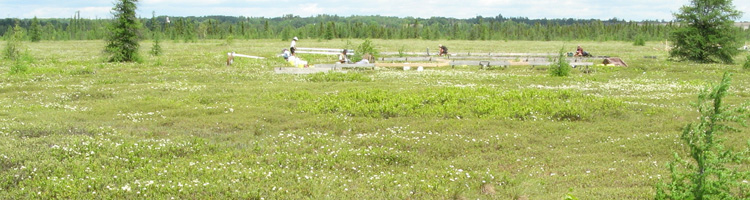
Figure 1. The ombrotrophic bog at Mer Bleue, near Ottawa , where studies are being conducted on gas exchange, plant production and decomposition and the effect of N and P additions. |

|
Figure 2. The eddy-covariance tower at Mer Bleue, at which Peter Lafleur and Elyn Humphreys have measured CO2 flux since 1998. |

|
Figure 3. The upper peat profiles at the bog and poor fen at Mer Bleue. |

|
Figure 4. The bog margin at Mer Bleue that consists of a partially drained beaver pond. We are interested in the response of vegetation and CO2 and CH4 fluxes to the atmosphere to the lowered water level. |

Figure 5. Mer Bleue "alumni", 1999. Back row: Mike Dalva , Doug Barr, Neil Comer, Birgit Isernhagen , Tim Moore, Colin Fraser. Middle row: Debbie Scanlon, Jenny-Marie Ferone , Charlotte Roehm , Kathleen Lysychyn , Jessica Paterson, Jukka Turunen . Front row: Steve Robinson, Nigel Roulet.

Fig. 6 Vegetation cover in the unfertilized plot (upper) and the denser and taller shrub cover in the NPK fertilized plot, which has removed mosses (lower). Scale is 50 cm.

|


|
Figure 7. Sites representing short (upper) and tall (lower) pocosins on the Coastal Plain of North Carolina, at which a 5-year litter decomposition study has been established. |


|
Figure 8. Sites representing restiad peatlands (upper Kopuatia, lower Whangamarino) in Waikato, North Island, New Zealand, at which a 5-year litter decomposition study has been established. |
|
Figure 9. A drained and harvested ombrotrophic bog, used for the production of peat moss. |

|
Figure 10. Vegetation establishment on a harvested peatland that has been proactively restored by researchers from Université Laval. Note the dominance of cotton-grass ( Eriophorum spp .) that colonizes early, though is not a dominant member of the original bog vegetation. |

|
Figure 11. A peatland that was block cut and abandoned about 25 years ago, in which vegetation has been allowed to establish naturally. Although the vegetation composition is similar to undisturbed bogs, our studies suggest that the restoration of vegetation still leaves the site as an emitter of CO2 and CH4 to the atmosphere. |

|
Figure 12. An old pasture in Panama being converted to a native tree plantation by Dr. Catherine Potvin in which we have determined the original soil for C, N concentration and mass and 13C signature. The soil will be sampled again in 2011 to establish changes in amount and source of soil C and N. |
GEOG-203 Environmental Systems
GEOG-305 Soils and Environment
GEOG-505 Global Biogeochemistry
Recent (since 2004) and Current Graduate Students: |
|
- Abraham, Muriel. 2004. Spatial variation in soil organic carbon and stable carbon isotope signature in a pasture and a primary forest in central Panamá. M.Sc. Thesis.
- Basiliko, Nate. 2004. Nutrient, substrate, and microbial-ecological links to decomposition and greenhouse gas production in northern peatlands. Ph.D. Thesis.
- Pelletier, Luc. 2005. Carbon dioxide and methane fluxes of three peatlands in the La Grande Rivière watershed, James Bay lowland, Canada. M.Sc. Thesis.
- Nicola McEnroe. 2008. Carbon biogeochemistry of open water pools on an ombrotrophic raised bog, James Bay, Quebec, Canada. Ph.D. thesis. (co-supervised with N. Roulet .
- Turgeon, Julie. 2008. Production and biodegradation of dissolved carbon, nitrogen and phosphorus from Canadian forest floors. Ph.D. thesis.
- Kothawala, Dolly. 2009. Controls on the soil solution partitioning of dissolved organic carbon and nitrogen in the mineral horizons of forested soils. Ph.D. thesis.
- Murphy, Meaghan. 2009. Getting to the root of the matter: variations in vascular root biomass and production in peatlands and responses to global change. Ph.D. thesis.
- Chong, Mandy. 2010. The microclimatic response to increasing shrub cover, and its consequent control on Sphagnum carbon dioxide exchange in an ombrotrophic bog. M.Sc. Thesis.
- Alfonso, Amanda. In prep. Uptake of organic nitrogen by bog plants. M.Sc. Thesis.
- De Young, Allison. In prep. Nitrous oxide emission and dynamics at bog and swamp peatlands. M.Sc. Thesis.
- Lai, Derrick. In prep. Carbon cycling in peatlands. Ph.D. thesis. (co-supervised with N. Roulet ).
- Lalonde, Mark. In prep. The determination of peatland soil moisture by hyperspectral remote sensing. M.Sc. Thesis. (co-supervised with M. Kalacska).
- Wang, Meng. In prep. Stoichiometric relationships in peatlands. Ph.D. thesis.
Publications in Refereed Journals and Conference Proceedings (2004 to present): |
|
Potvin, C., N. Buchmann, J. Monteza. T.R. Moore, M. Murphy, Y. Oelmann, M. Scherer-Lorenzen, B.L. Turner, W. Wilcke, S. Wolf, L. Mancilla, & F. Zeugin in press. An ecosystem approach to biodiversity effects: carbon pools in a tropical tree plantation. Forest Ecology & Management.
Xing, Y., J. Bubier, T. Moore, M. Murphy, N. Basiliko, S. Wendel and C. Blodau in press. The fate of 15N-nitrate in a northern peatland impacted by long term experimental nitrogen, phosphorus and potassium fertilization. Biogeochemistry DOI 10.1007/s10533-010-9463-0.
Moore, T.R., A.J. Trofymow, C.E. Prescott, B. Titus & CIDET Working Group in press. Nature and nurture in the continuum of C, N and P from litter to soil organic matter in Canadian forests. Plant & Soil DOI: 10.1007/s11104-010-0563-3.
Wu, J., N.T. Roulet, T.R. Moore, P. Lafleur and E. Humphreys in press. Dealing with microtopography of an ombrotrophic bog for simulating ecosystem-level CO2 exchanges. Ecological Modelling.
Teklemariam, T., P.M. Lafleur, T.R. Moore, N.T. Roulet & E.R. Humphreys 2010. The direct and indirect effects of inter-annual climate variability on ecosystem carbon dioxide exchange at a temperate ombrotrophic bog. Agricultural & Forest Meteorology 150: 308-321.
Juutinen, S., J.L. Bubier & T.R. Moore 2010. Responses of vegetation and ecosystem CO2 exchange to nine years of fertilization at Mer Bleue bog. Ecosystems 13: 874-887. DOI: 10.1007/s10021-010-9361-2.
Murphy, M.T. and T.R. Moore 2010. Linking root production to aboveground plant characteristics and water table in a temperate bog. Plant & Soil 336: 219-231. DOI 10.1007/s11104-010-0468-1.
Peichl, M., A.A. Arain, S. Ullah and T.R. Moore 2010. Forest floor CO2, CH4 and N2O exchanges in an age-sequence of eastern white pine forests. Global Change Biology 16: 2198–2212.
Frasier, R., S. Ullah and T.R. Moore 2010. Nitrous oxide consumption potentials of well-drained forest soils of southern Québec, Canada. Geomicrobiology 27: 53-60.
Dinsmore, K., M. Billett and T.R. Moore 2009. Transfer of carbon dioxide and methane through the soil-water-atmosphere system at Mer Bleue peatland, Canada. Hydrological Processes 23: 330-341.
Kothawala, D.N., T.R. Moore and W.H. Hendershot 2009. Soil properties controlling adsorption of dissolved organic carbon to mineral soils. Soil Science Society of America Journal 73: 1831-1842.
Kothawala, D.N. and T.R. Moore 2009. Adsorption of dissolved N by forested mineral soils. Canadian Journal of Forest Research 39: 2381-2390.
McEnroe, N., N.T. Roulet and T.R. Moore 2009. Do pool surface area and depth control CO2 and CH4 fluxes from an ombrotrophic raised bog, James Bay, Canada? JGR-Biogeosciences 114: G01001, doi:10.1029/2007JG000639.
Moore, T.R. 2009. Dissolved organic carbon production and transport in Canadian peatlands. pp. 229-236 in A.J. Baird, L.R. Belyea, X. Comas, A.S. Reeves and L.D. Slater (eds.) Carbon Cycling in Northern Peatlands. Geophysical Monograph 184, American Geophysical Union.
Murphy, M.T., R. Laiho and T.R. Moore 2009. Effects of water table drawdown on root production and aboveground biomass in a boreal bog in southern Finland. Ecosystems 12: 1268-1282.
Murphy, M.T., A. McKinley and T.R. Moore 2009. Variations in above- and below-ground vascular plant biomass and water table on a temperate ombrotrophic peatland ombrotrophic peatland. Botany 87: 845-853.
Ullah, S., R. Frasier, L. Pelletier and T. R. Moore 2009. Summer fluxes of greenhouse gases from boreal forest soils, Québec, Canada. Canadian Journal of Forest Research 39: 666-680.
Ullah, S. and T.R. Moore 2009. Soil drainage and vegetation controls of nitrogen transformation rates in deciduous forest soils, southern Quebec. JGR-Biogeosciences 114: doi:10.1029/ 2008JG000824.
Billett, M.F. and T.R. Moore 2008. Supersaturation and evasion of CO2 and CH4 in surface waters at Mer Bleue peatland, Canada. Hydrological Processes 22: 2044-2054.
Kothawala, D.N., T.R. Moore and W.H. Hendershot 2008. Adsorption of dissolved organic carbon to mineral soils: A comparison of four isotherm approaches. Geoderma 148: 43-50.
Moore, T.R., D. Paré, and R. Boutin 2008. Production of dissolved organic carbon in Canadian forest soils. Ecosystems 11: 740-751.
Moore, T.R., A.J. Trofymow, M. Siltanen and L.M. Korz 2008. Litter decomposition and N and P dynamics in peatland and upland sites over 12 years in central Canada. Oecologia 157: 317-325.
Ullah, S., R. Frasier, L. King, N. Picotte-Anderson and T.R. Moore 2008. Potential fluxes of N2O and CH4 from soils of three forest types in eastern Canada. Soil Biology and Biochemistry 40: 986-994.
Basiliko, N., C. Blodau, P. Bengtson, C. Roehm & T.R. Moore 2007. Regulation of microbial greenhouse gas fluxes across natural, commercially-mined, and restored northern peatlands. Ecosystems 10: 1148-1165.
Moore, T.R., J.L. Bubier & L.A. Bledzki 2007. Litter decomposition in temperate peatlands: the effect of substrate and site. Ecosystems10: 949-963.
Peichl, M., T.R. Moore, A. Arain, M. Dalva, D. Brodkey & J. McLaren 2007. Dissolved organic carbon in a white pine plantation sequence, southern Ontario. Biogeochemistry 86: 1-17.
Potvin, C. & 17 others 2007. A participatory approach to the establishment of a baseline scenario for a reforestation CDM project. Mitigation and Adaptation of Strategies for Global Change 12: 1341-1362.
Wieder, K., J. Canadell, J. Limpens, T. Moore, N. Roulet & G. Schaepman-Strub 2007. Peatlands and the Carbon Cycle - From Local Processes to Global Implications. First International Symposium on Carbon in Peatlands, Wageningen, the Netherlands , 15-18 April, 2007. EOS, Transactions American Geophysical Union 88: 295.
Blodau, C., B. Mayer, S. Peiffer & T.R. Moore 2007. Support for an anaerobic sulfur cycle in two Canadian peatland soils. JGR-Biogeosciences112:G02004, doi: 10.1029/2006JG000364.
Blodau, C., N.T. Roulet, T. Heitmann, H. Stewart, J. Beer, P. Lafleur and T.R. Moore 2007. Belowground carbon turnover in a temperate ombrotrophic bog. Global Biogeochemical Cycles21: doi: GB1021 10.1029/2005GB002659.
Bubier, J.L., T.R. Moore & L.A. Bledzki 2007. Effects of nutrient addition on vegetation and carbon cycling in an ombrotrophic bog. Global Change Biology13: 1168-1186.
Moore , T.R. and B.R. Clarkson 2007. Dissolved organic carbon in New Zealand peatlands. New Zealand Journal of Freshwater and Marine Research41: 137-141.
Pelletier, L., T.R. Moore, N.T. Roulet, M. Garneau and V. Beaulieu-Audy 2007. Methane fluxes from three peatlands in the La Grande Rivière watershed, James Bay lowland, Canada. JGR-Biogeosciences112: G01018, doi:10.1029/2006JG000216.
Roulet N.T., P.M. Lafleur, P.J.H. Richard, T.R. Moore, E.R. Humphreys and J. Bubier 2007. Contemporary carbon balance and late Holocene carbon accumulation in a northern peatland. Global Change Biology 13: 397-411.
Basiliko, N., J.L. Bubier, R. Jeannotte and T.R. Moore 2006. The effect of nutrient input on carbon and microbial dynamics in an ombrotrophic bog. Geomicrobiology23: 531-543.
Blodau, C., N. Basiliko, B. Mayer and T.R. Moore 2006. The fate of experimentally deposited nitrogen in mesocosms from two Canadian peatlands. Science of the Total Environment364: 215-228.
Bubier, J., T.R. Moore and G. Crosby 2006. Fine-scale vegetation distribution in a cool temperate bog. Canadian Journal of Botany84: 910-923.
Moore, T. and N. Basiliko 2006. Decomposition. Pages 126-143 in R.K. Wieder & D.H. Vitt (eds.) Boreal Peatland Ecosystems , Ecological Studies Vol. 188, Springer-Verlag.
Moore, T.R., A.J. Trofymow, C.E. Prescott, J. Fyles, B.D. Titus & CIDET Working Group 2006. Patterns of C, N and P dynamics in decomposing foliar litter in Canadian forests. Ecosystems9: 46-62.
Moore , T.R., P.M. Lafleur, D.M.I. Poon, B.W. Heumann, J.W. Seaquist and N.T. Roulet 2006. Spring photosynthesis in a cool temperate bog. Global Change Biology12: 2323-2335.
Roulet, N. and T.R. Moore 2006 . News and Views - Environmental chemistry : Browning the waters. Nature444: 283-4.
Wironen, M. and T.R. Moore 2006. Exotic earthworm invasion of an old-growth forest in southern Quebec and effects on soil carbon and nitrogen. Canadian Journal of Forest Research 36: 845-854.
Basiliko, N., T.R. Moore, P.M. Lafleur and N.T. Roulet 2005. Seasonal and inter-annual decomposition, microbial biomass, and nitrogen dynamics in a Canadian bog. Soil Sci.170: 902-912.
Cleary, J., N. Roulet and T.R. Moore 2005. Greenhouse gas emissions from Canadian peat extraction, 1990-2000: A life-cycle analysis. Ambio34: 456-461.
Lafleur, P., T.R. Moore, N. Roulet and S. Frolking 2005. Ecosystem respiration in a cool temperate bog: dependency on peat temperature and moisture content. Ecosystems8: 619-629.
Bubier, J., T. Moore, K. Savage and P. Crill 2005. A comparison of methane flux in a boreal landscape between a dry and a wet year. Global Biogeochemical Cycles19 # doi 10.1029/2004GB002351.
Moore , T.R., A.J. Trofymow, M. Siltanen, C. Prescott and CIDET Working Group 2005. Litter decomposition and carbon, nitrogen and phosphorus dynamics in upland forest and peatland sites, central Canada. Canadian Journal of Forest Research 35: 133-142.
Basiliko, N., R. Knowles and T.R. Moore 2004 . On the roles of moss species and habitat in methane oxidation in northern peatlands. Wetlands24: 178-185.
Blodau, C., N. Basiliko and T.R. Moore 2004. Carbon turnover in peatland mesocosms exposed to different water table levels. Biogeochemistry67: 331-351.
Glatzel, S., N. Basiliko and T.R. Moore 2004. CO2 and CH4 production potentials of peats from natural, harvested and restored sites, eastern Québec, Canada. Wetlands24: 261-267.
Marinier, M., S. Glatzel and T.R. Moore 2004 . The role of cotton-grass (Eriophorum vaginatum ) in CO2 and CH4 fluxes from restored peatlands, eastern Canada. Écoscience 11: 141-149.
Moore , T.R., C. Blodau, J. Turunen, J., N.T. Roulet and P.J.H. Richard 2004. Recent rates of N and S accumulation in peatlands, eastern Canada. Global Change Biology11: 356-367.
Moore , T.R. and J. Turunen 2004. Subsoil accumulation of carbon beneath forest and peat in Michigan. Soil Science Society of America Journal68: 690-69.
Potvin, C., E. Whidden and T.R. Moore 2004. A case study of carbon pools under three different land-uses in Panamá. Climatic Change 67: 291-307.
Turunen, J., N. Roulet, T.R. Moore and P. Richard 2004. Nitrogen deposition and increased carbon accumulation in ombrotrophic peatlands in eastern Canada. Global Biogeochemical Cycles18 # 3, doi 10.1029/2003GB002154. |